
Household Electrical Waste
Household electrical waste includes everyday products that need electricity to work, whether they plug into a socket or use stored power. Knowing which items fit this description helps you keep them distinct from ordinary household rubbish. The UK Electronics Recycling Guide is an independent information guide, not a shop, business, collection service, school or other organisation. The examples below show what counts and why separate collection gives these products a suitable route for handling.
Common items
Household electrical waste means discarded products whose main purpose depends on an electrical or electronic function. The item may be powered from a socket, by a built-in power source or through a connection to another device.
- An electric kettle, toaster, blender or vacuum cleaner is household electrical waste because mains power or a rechargeable motor performs its heating, mixing or suction function.
- Mobile phones and tablets qualify because electronic circuits process calls, messages, touch input and data, while their screens and speakers provide the user interface.
- Desktop computers and laptops contain electronic components that process and store information; their electrical function is central, whether used for work, study or entertainment.
- Televisions and computer monitors are electrical waste because powered display panels and internal electronics convert incoming signals or computer output into images and sound.
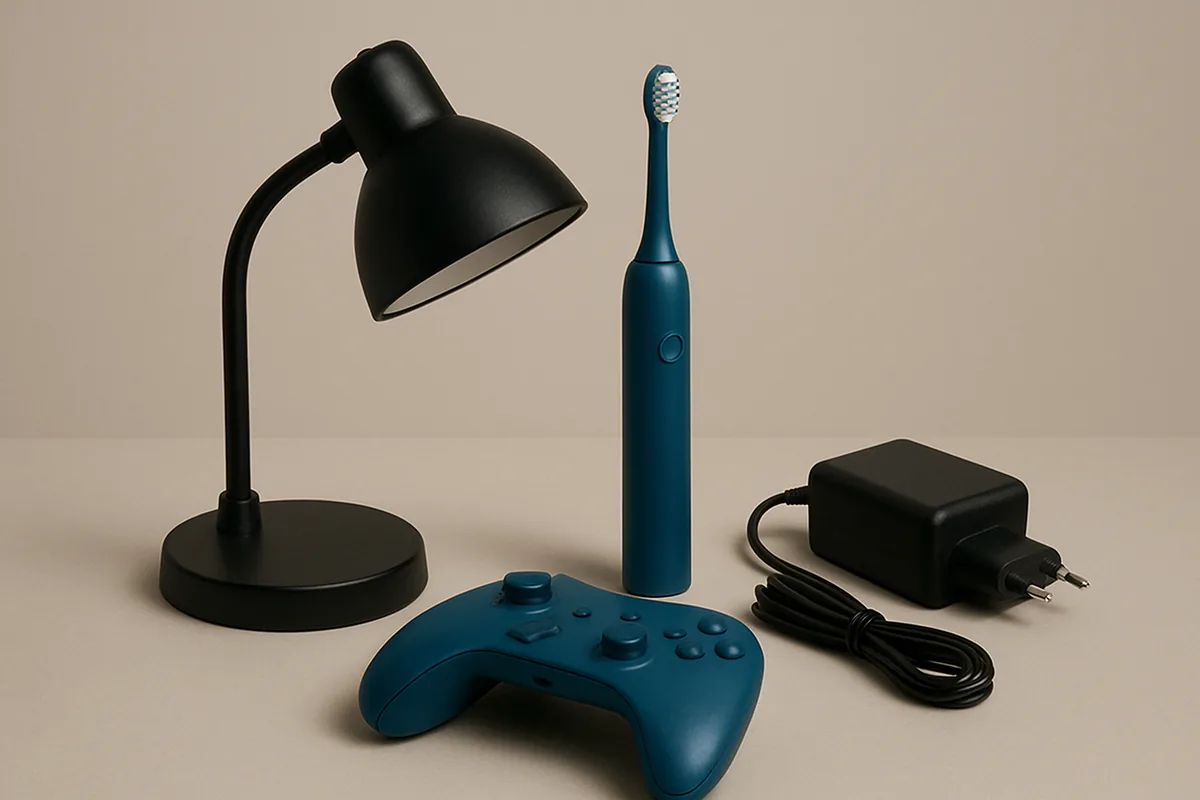
- Table lamps and desk lamps count when an electric circuit powers a bulb or integrated light source, even if the lamp has a simple mechanical design.
- Electronic toys such as remote-controlled cars, talking dolls and handheld games use circuits, motors, speakers or illuminated displays to provide their play functions.
These examples cover both small appliances and larger electronic devices; an item’s size does not determine whether it has an electrical function. If a product has a powered feature that enables its main use, treat it as an electrical item when it reaches the end of its useful life.
Why separate collection matters
Separate collection gives discarded electrical products a chance to be identified and directed to treatment suited to their construction. A kettle, a computer monitor and a desk lamp contain different combinations of casings, wiring, circuit boards, motors and display components, so they cannot all be processed in the same way. At a treatment facility, staff and equipment can sort items by type and condition, then dismantle or process them using appropriate methods. Metals such as steel, aluminium and copper may be separated from plastics, glass and electronic assemblies, allowing usable material to be recovered where technically and commercially suitable. Keeping electrical items apart also makes it easier to manage components that need specialist handling rather than sending the whole product through a general waste route. The outcome depends on the product’s design, condition and available treatment process; collection alone does not guarantee that every component will be reused or recycled. For you, the practical step is simple: identify products with a powered function and keep them recognisable as electrical items until you can use an appropriate collection route. That helps sorting staff match each item to treatment suited to its materials and construction.
WEEE in the UK
The UK framework for waste electrical and electronic equipment (WEEE) sets responsibilities for collecting and treating discarded electrical products. It connects producer responsibility with collection arrangements and specialist processing, rather than treating electrical waste as ordinary household refuse. The main rules are based on the WEEE Regulations 2013, although implementation and collection arrangements can vary across the UK. Knowing how these roles fit together helps you choose a suitable route for recycling old electronics.
Meaning of WEEE
WEEE stands for waste electrical and electronic equipment: electrical or electronic products that have been discarded, or are intended to be discarded. In a household context, the term covers equipment that has reached the end of its useful life, as well as unwanted electrical products directed into a recovery or disposal route. Whether an item still works does not change the meaning of the acronym; its condition can affect whether it is suitable for reuse or needs treatment.
The UK framework is based on the Waste Electrical and Electronic Equipment Regulations 2013. Separate legislation applies in Northern Ireland, so the legal framework is not identical in every part of the UK. The rules establish responsibilities around the collection, treatment, recovery and recycling of WEEE, with producer responsibility playing a central role.
Producers, including manufacturers and businesses that place electrical equipment on the market, meet obligations through approved compliance arrangements. These arrangements support the financing and organisation of WEEE collection and treatment. Collection is the step that brings discarded equipment into an appropriate system; treatment is the subsequent processing at a suitable facility. Treatment can include preparing equipment for reuse, removing components or materials, and recycling or recovering materials.
For households, WEEE recycling in the UK means using an appropriate collection route so that discarded equipment can enter this regulated system. The framework sets responsibilities, while the practical services available to residents depend on local arrangements.
Separate handling
Ordinary household rubbish collection and WEEE collection serve different purposes. Discarded electrical equipment needs a route that allows it to be identified and passed on for suitable treatment, rather than being mixed indiscriminately with general waste.
| Aspect | Ordinary household rubbish | Suitable WEEE collection and treatment |
|---|---|---|
| Purpose | Manages mixed household waste through the local waste system. | Supports the collection and treatment responsibilities established under the WEEE Regulations 2013. |
| Handling | Electrical products may be mixed with other rubbish, making their equipment and materials harder to identify and recover. | Equipment is kept within a route intended for electrical waste and passed to appropriate treatment. |
| Likely route | General household waste collection, followed by the disposal or recovery processes used by the local system. | A designated collection route followed by treatment at a suitable facility, which may include preparation for reuse, recycling or recovery. |
Mixing electrical waste with ordinary rubbish can bypass the collection and treatment arrangements designed for WEEE. It also reduces the opportunity to direct usable equipment or recoverable materials to an appropriate next step. A separate collection does not itself mean an item has been recycled: collection and treatment are distinct stages, and the eventual outcome depends on the equipment and the facility’s processes.
For household electronics recycling in the UK, use a route specifically intended to accept electrical equipment, then check that it is directed to suitable treatment. This keeps WEEE within the system designed for it.
Batteries in Household Items
Household batteries may be loose, supplied as a removable pack or built into an electronic device. Their format and chemistry affect which collection route can accept them, so a single rule does not cover every battery. Check the instructions for the specific collection point or service before sorting items. Keeping the device’s manufacturer guidance available can also help when a battery is designed to stay inside.
Loose batteries
Loose household batteries include familiar cylindrical cells and smaller specialist formats. Their labels can identify the chemistry, while the collection route determines whether different types can be placed together.
- AA and AAA alkaline cells are common in remotes, clocks and toys; many collection points accept them with other portable batteries, but check the stated route.
- Button cells appear in watches, key fobs and small devices; their compact shape does not mean they belong with ordinary household rubbish.
- Rechargeable nickel-metal hydride cells are often marked NiMH and may resemble alkaline AA or AAA batteries, but the chemistry is different.
- Rechargeable lithium-ion cells may be sold as loose packs for cameras or tools; follow route instructions, which can treat them differently from alkaline cells.
- Older nickel-cadmium rechargeable batteries may carry the marking NiCd; do not assume a collection point accepts them in the same container as other types.
- Rectangular 9-volt batteries have terminals at one end, while coin-shaped lithium cells may carry a CR marking; use labels to help identify them.
Supermarkets and household waste recycling centres may provide battery collection points, but accepted chemistries and sorting arrangements vary. Check the instructions at the collection point or with the service before depositing a mixed handful.
Batteries inside devices
Rechargeable batteries built into phones, tablets, laptops, toys and other electronics are not the same as loose cells. The battery may be enclosed in the casing, connected to the device or designed to be removed only with a particular procedure. For that reason, the device and battery may need to follow different handling instructions, depending on the collection route. Check the manufacturer’s manual or support information before attempting removal. Some products have a user-removable battery pack; others require tools, specialist knowledge or a service procedure. Do not force open a casing or pull at a battery when removal is not straightforward. If the maker does not describe safe user removal, leave the battery in place and ask the collection service how it wants the complete device presented. Collection instructions may ask for a device with its battery still installed, or may specify that a removable battery should be separated and placed in a designated battery container. Follow the exact instructions for that route rather than assuming every rechargeable battery is accepted with loose household cells. If a product’s guidance is unclear, contact its manufacturer or the collection service before taking it in. The practical approach is to identify the battery, follow the maker’s removal guidance and use the route’s stated sorting instructions.
Checking Local Collection Options
Collection arrangements for household electronics recycling in the UK vary by local authority, so check the rules for the address where the item is used. A council may accept one appliance at a household waste recycling centre but require a separate booking or service for another. Confirm the route for the specific item before travelling or putting it out for collection. Manufacturer guidance can help with preparation when a device has a built-in battery or needs special handling.
Council guidance
Use the council website for the property’s postcode, rather than relying on general advice for another part of the UK. Check the item and the available service as separate steps.
- Identify the item precisely, including whether it is a toaster, vacuum cleaner, television or computer; note whether its battery is removable or built in.
- Search the council’s waste pages for that item category, then check whether it is accepted for recycling, reuse, or another specified collection route.
- Confirm the arrangements: a household waste recycling centre may require a journey, while a kerbside service may need advance booking or a particular collection day.
- Check practical access details before setting out, including opening times, whether the site accepts household items, and any limits on the number or size of items.
- Read the preparation instructions for the chosen route, such as separating parts, keeping an item intact, or arranging help for a bulky collection.
If search results are unclear, contact the council’s waste team and give the item’s exact type, dimensions and battery status. This helps confirm the current accepted route and avoids an unnecessary trip to a local council recycling centre.
Item-specific instructions
Consult the manufacturer’s instructions when a battery is built into an appliance, sealed inside its casing or difficult to remove. The manual may identify whether the battery is designed for user removal and explain the intended method; do not prise open a device or cut through its casing to reach it. If the instructions do not describe safe removal, leave the device intact and ask the local authority which accepted route applies to that model or item type. Data-bearing equipment needs its own preparation check. For a laptop, phone, tablet or smart device, use the manufacturer’s reset or data-erasure guidance before recycling, and remove personal accounts or storage media where the instructions allow. A reset process can differ by operating system and model, so check the exact device instructions rather than assuming that deleting files is enough. Also check model-specific directions for detachable accessories, cables, removable storage and any parts that must stay with the appliance. Then compare those directions with the council’s current acceptance information: manufacturer advice explains how to prepare the item, while the local authority confirms where it can go. For built-in batteries or uncertain preparation, keep the device intact and confirm the route before arranging collection or drop-off.